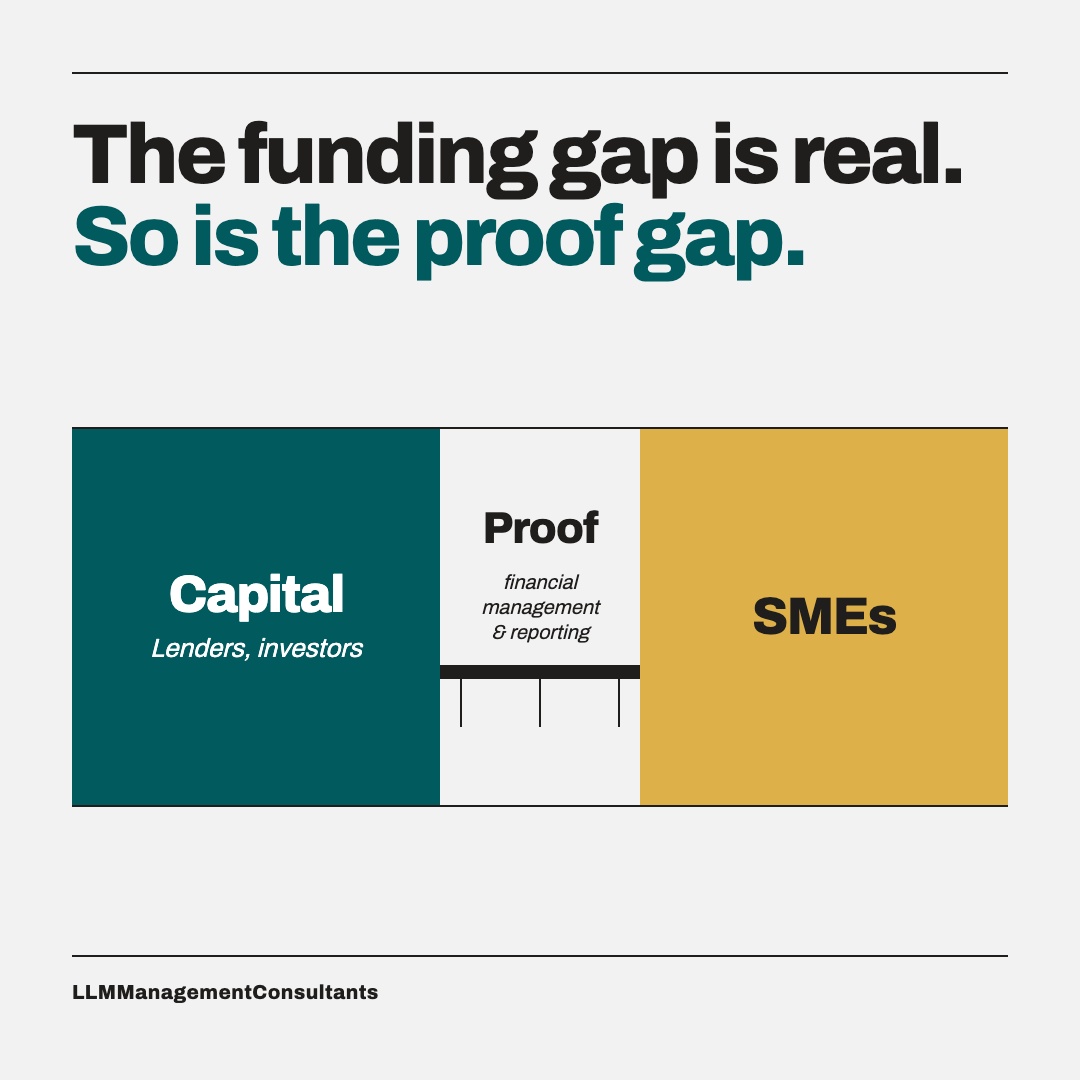
A World Bank assessment of MSME access to finance in Botswana identified unreliable financial management and reporting among the barriers businesses face, alongside informality and challenges within the lending market.
Funding readiness begins with how a business is run, long before anyone fills in a funding application.
Access to finance remains one of the biggest constraints on SMEs in Botswana. The World Bank’s 2023 assessment of MSME access to finance cites survey findings that only 8% of MSMEs received a bank loan in 2019, and more than half received no credit at all.
Part of that gap sits with the market: lender appetite, collateral requirements and the cost of funding. But the assessment also identified barriers within businesses themselves, namely informality, low financial literacy, and unreliable financial management and reporting. Banks reported that SMEs mixing personal and business finances and making errors in their reports, makes their records less reliable and their future cash flows harder to predict.
When a lender cannot rely on the numbers, it compensates with higher pricing, heavier collateral demands, or a decline. The business may be sound, but it cannot yet prove it.
These are areas where professional finance support can make a practical difference.
Where the work usually begins
Most clients first approach me because they need financial statements for statutory compliance. That is often their understanding of what an accountant provides.
Those engagements also show where the business behind the statements can be strengthened: how transactions are recorded, how money is managed, who is accountable, and whether the owner understands what the numbers are saying.
Compliance is the starting point, not the destination. At LLM, I see three connected ways to support that progress.
1. Establishing structure and accountability
A growing business needs clear financial responsibilities, documented processes and appropriate controls.
In practice, this means separating business and personal finances, keeping supporting documents for every transaction, setting approval limits, and establishing a regular reporting cycle. These steps make financial management consistent rather than dependent on the owner’s memory.
They also show a funder how money moves through the business, who makes decisions, and how those decisions are monitored. For a lender, that is evidence that the business can be trusted with capital and will still function as it grows beyond its founder.
2. Developing financial understanding
An owner should be able to discuss their business’s financial position with confidence, whether that’s with their team, their bank or a potential investor.
That means understanding why revenue is different from profit, why profit does not necessarily mean cash is available, and how pricing, customer payment terms and borrowing affect the business. For example, a business can win a large contract and still run short of cash if it must pay suppliers months before the customer pays.
Part of my role is to explain the numbers in the context of the decisions the owner needs to make, and to help them ask better questions. An owner who understands their numbers negotiates differently, borrows more carefully and spots problems earlier.
3. Establishing reliable financial management and reporting
This includes appropriate accounting systems, reconciled records, regular management reports and cash-flow planning.
Financial statements become more useful when they are supported by records kept throughout the year, rather than reconstructed at year-end. Forecasts become more credible when they connect to actual performance and clearly explain what is expected to change.
Over time, this builds a track record, which is what a funder is really assessing. The World Bank describes a good credit history as a form of “reputational collateral”: proof of reliability that can, over time, reduce a lender’s dependence on property and personal guarantees.
The questions behind every funding request
Together, these foundations help a business answer the questions every lender or investor will ask, whether directly or not:
How has the business performed, and can the records support that? How much funding does it need, and why that amount? What will that funding enable? What cash will support repayment, or what could generate an investor’s return? What happens if the plan falls short?
A business that can answer these clearly, with evidence, is a very different proposition from one that cannot.
Is this the right funding?
Funding readiness also means helping the owner judge whether the proposed funding is right for the business. Not all capital is good capital. Short-term, high-cost finance used to plug a long-term gap, or debt taken on before the business can reliably service it, can create more pressure than it relieves. Sometimes the right answer is a different structure, a smaller amount, a later date, or fixing working capital first.
What this can and cannot do
Stronger structures and reliable information cannot remove every financing barrier. Lender appetite, collateral requirements, funding costs and commercial viability still matter.
But they can reduce uncertainty and give lenders and investors a clearer basis for assessing an opportunity. They also give the owner something just as valuable: a clearer view of their own business.
This is the broader purpose of strategic finance, and the work I built LLM to do: helping businesses develop financial visibility, stability and a sound basis for growth.
If your next stage requires funding, the preparation starts with the financial habits and structures you build today.